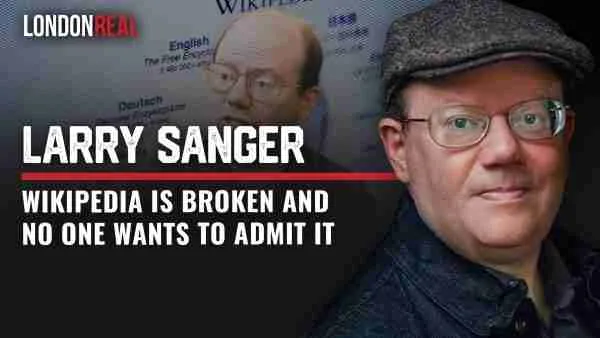





Today’s episode features Larry Sanger — philosopher, internet pioneer, and co-founder of Wikipedia, one of the most influential knowledge platforms in human history.
Larry joins me to explore a controversial and urgent question: has Wikipedia drifted away from its founding mission — and what does that mean for truth, knowledge, and the future of information online?
Larry helped create a platform that reshaped how billions of people access knowledge. But he has since become one of its most prominent critics, arguing that neutrality, open inquiry, and good-faith debate have gradually been replaced by ideological enforcement, institutional control, and consensus-driven narratives.
In this episode, we examine how knowledge itself has become politicised in the digital age. Larry explains how editorial governance evolved as Wikipedia scaled globally, why consensus is often mistaken for truth, and how unpopular or dissenting viewpoints can quietly disappear through procedural gatekeeping rather than outright censorship.
We also explore the collapse of public trust in traditional institutions — including media, academia, and expert communities — and whether this crisis of credibility is reversible. Larry shares his perspective on how institutional capture operates, why power often replaces truth in large information systems, and how soft censorship shapes public perception without users even realising it.
A major focus of our discussion is artificial intelligence and what Larry calls the growing “epistemic risk” facing humanity. We examine how AI models rely heavily on existing internet knowledge bases, how bias can be amplified at machine scale, and why flawed data sources could shape global understanding for generations to come.
Finally, Larry discusses whether decentralised knowledge systems could offer a solution. We dive into the philosophical and technical challenges of building trustworthy information platforms, why governance and incentives matter more than intentions, and what must change if society wants to preserve objective truth in a rapidly evolving digital landscape.
This conversation is not just about Wikipedia. It’s about the future of knowledge itself — who controls it, how it is shaped, and whether truth can survive in an era dominated by algorithms, institutions, and artificial intelligence.